Why AI Search Understands Your Content Better Than Google Ever Did
Here is a query typed into search engines every single day: "I have a headache after working on my laptop for 8 hours."
Google sees the words: headache, laptop, 8 hours. It returns a ranked list of pages that contain those keywords - Healthline, Reddit threads, neurology clinic blogs. You scroll, click, compare, and piece together an answer yourself.
An AI search engine reads the situation. Someone has been staring at a screen for most of a working day. The likely causes include digital eye strain, neck tension from poor posture, dehydration, and screen brightness. A useful answer covers all of that, suggests what to do right now, and flags when the headache might need medical attention - in one place, directly.
That gap - between matching words and understanding context - is the single most important shift happening in search right now. And most websites are still writing for the first model.
The Same Query, Two Completely Different Experiences
The screenshots below make this concrete. No commentary needed.
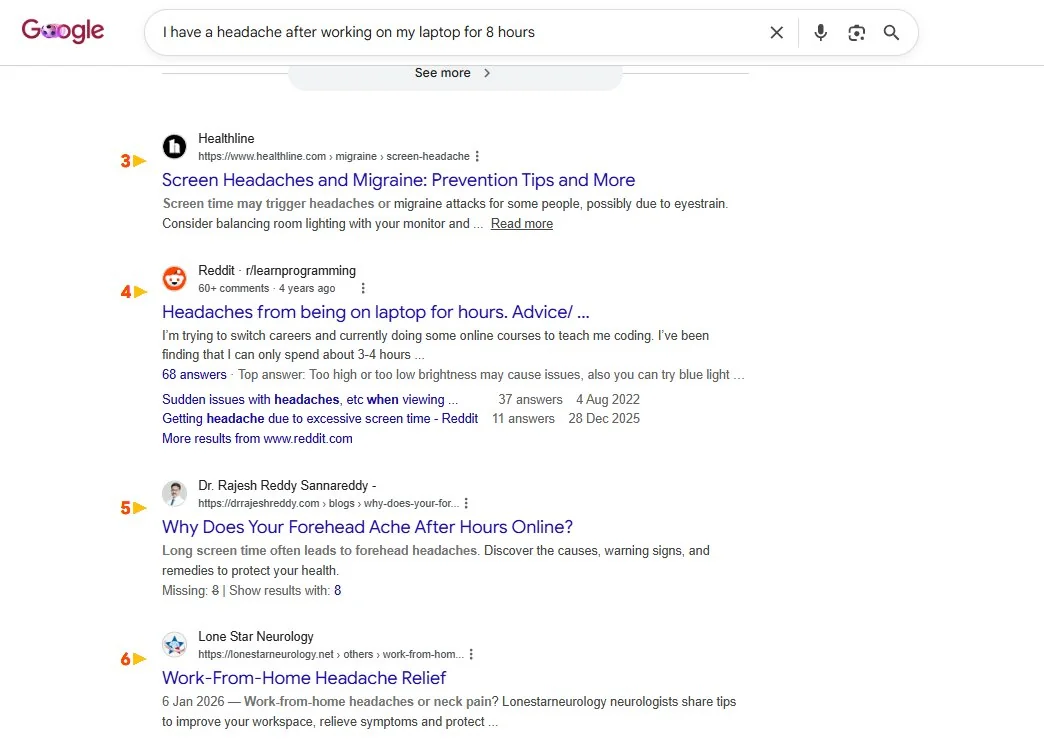
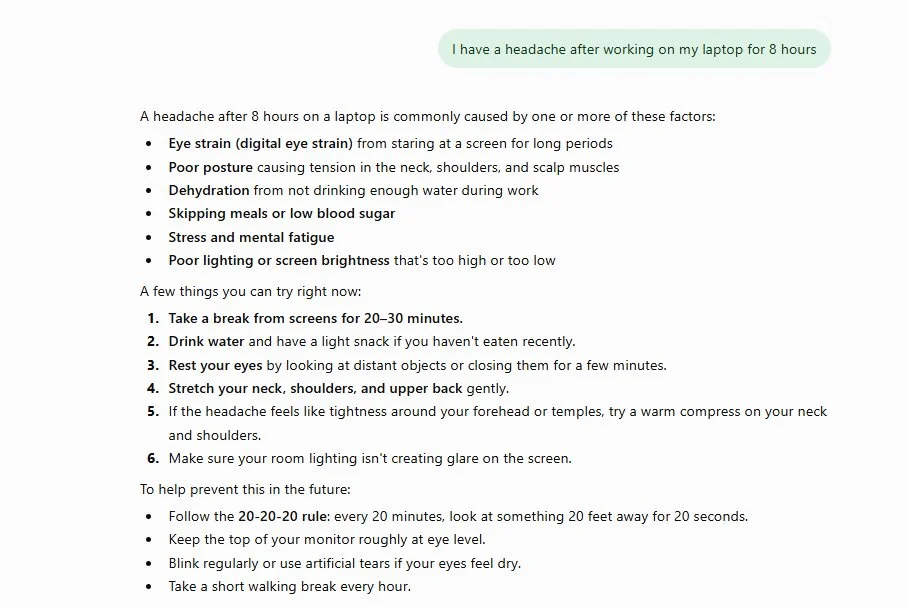
The AI answer addresses eye strain, poor posture, dehydration, skipping meals, poor lighting, and screen brightness - none of which appear in the original query. It then provides a prioritised action list and prevention advice. The model inferred all of this from context. A keyword-matching system cannot do that.
What Changes Between the Two Models
Traditional search is built on document retrieval. You type words, the engine finds documents containing those words, and it ranks them by authority signals. Intent is inferred, not truly understood. Google has become excellent at this inference over 25 years, but it is still fundamentally pattern matching at scale.
AI search engines - ChatGPT, Perplexity, Gemini, Google AI Overviews - work from a different model. Large language models are trained on enormous amounts of human text, which gives them a working understanding of how people communicate, what situations produce which kinds of questions, and what a genuinely complete answer looks like. When you ask a question, the model is not finding a document. It is assembling an answer from its understanding of your context. Gemini is the most consequential example, because the same reasoning now sits on top of Google's own results in AI Overviews; positioning your content for that overlap is the focus of my Gemini SEO consulting.
- Matches keywords in query to page content
- Ranks by backlinks and authority signals
- Returns a list of pages to sift through
- Intent is inferred from query patterns
- Win by: keyword density, titles, meta tags
- Reads the situation behind the query
- Assembles a direct, contextual answer
- Cites sources that answer the full context
- Intent is understood from the full query
- Win by: answer depth, entity, structure
This is precisely why SEO, AEO, and GEO are becoming distinct practices. A page that ranks on Google for "headache remedies" may never get cited by an AI engine if it does not address the specific context - screen fatigue, eye strain, posture, the 8-hour workday - that the query is actually about.
What This Means for Your Content
If AI search reads situations rather than keywords, the content brief changes significantly. You stop asking: what keyword do I want to rank for? You start asking: what situation is this person in, and what does a complete answer to that situation actually look like?
A page that covers the entire context of a query - causes, immediate fixes, prevention, and when to escalate - will be cited far more reliably by AI engines than a generic article that happens to contain the right keywords. This is the foundational idea behind answer engine optimisation, and it applies across every industry I work with.
Three things change in practice.
Answer first, explain second. AI engines extract citable sentences. If your clearest answer is buried in paragraph six, the model skips you. The opening paragraph needs to give the most useful direct answer before you go into detail. This is non-negotiable for LLM visibility.
Write for the situation, not the search term. Map the full context behind any query before you write. What brought the person to this question? What are the most likely follow-up needs? What would a genuinely helpful answer include that a keyword-stuffed page would skip? This process looks different across each industry but the logic is identical.
Structure for extraction. Headers, FAQ sections, and structured lists are not just readability features - they are the formats AI engines parse most reliably. Your page needs to function as a structured data source, not just a readable article.
Does Traditional SEO Still Matter?
Yes - and significantly. Technical SEO, clean crawlability, structured data, and entity clarity all feed AI citation quality directly. Bing powers ChatGPT Search, which means Bing indexing is a direct AI visibility lever that most teams ignore entirely.
What changes is the weighting. Keyword density matters less. Context depth, answer structure, and source credibility matter more. The brands winning in AI search in 2026 are not abandoning SEO fundamentals - they are building on them with an intent-first content layer on top.
Frequently Asked Questions
How does AI search understand user intent differently from Google?
What kind of content gets cited by AI search engines?
Does traditional SEO still matter if AI search reads context?
How do I optimise content for AI search intent?

Anshul Rana
I am an SEO, AEO, and GEO specialist with 8+ years of experience helping businesses get found on Google and AI search platforms like ChatGPT, Gemini, and Perplexity. I hold the Top Rated Plus badge on Upwork (top 3% of freelancers) with a 100% Job Success Score, and I have worked with 1,000+ websites across India, Australia, the US, and the UK.
Related Articles
Want your content cited in AI search answers?
I build the intent-first content structure, entity signals, and AEO frameworks that get brands cited in ChatGPT, Perplexity, and Google AI Overviews.